
Performance & benchmarks
Every real BC-250 benchmark on SkillFishOS — screenshots, full settings, clocks, voltages, temperatures and power.
This is the complete benchmark section: every run was done on our own BC-250 with SkillFishOS, with real screenshots, all the settings used, and the telemetry of clocks, voltages, temperatures, power and fan recorded during the run.
Warning: Silicon lottery + cooling. The numbers hold for this chip with adequate cooling. The stock cooler is marginal: “back-to-back” comparisons without pauses are skewed by heat-soak — let the card cool a few minutes between runs.
Test conditions (test rig)
Apply to all benchmarks below unless stated otherwise.
| Item | Value |
|---|---|
| Board | AMD BC-250 — Zen 2 “Oberon” + RDNA 2 “Cyan Skillfish” APU (gfx1013) |
| Memory | 16 GB GDDR6 unified (UMA) |
| Compute Units | 40 / 40 active (routed live, see GPU) |
| Kernel | 7.0.10-skillfishos (linux-tkg) — the version these numbers were taken with; 7.1.7 re-measured within 2%; we ship 7.2.4 today |
| Driver | Mesa 26.0.8 — RADV (Vulkan) / radeonsi (OpenGL), ACO; today we ship our own build in skillfish-mesa-gfx1013 |
| GPU governor | cyan-skillfish (preset system, retired September 2026) — idle 350 MHz / 700 mV, load 2230 MHz / ~1000 mV |
| OC profile | Turbo/Crazy (GPU cap 2230 MHz, CPU 3.9–4.0 GHz) — presets retired; the GPU now uses the V/F governor with a ceiling and the Cautious/Balanced/Performance presets, see GPU & overclock |
| Thermal cap | 85 °C (SMU + thermal-guard), fan on auto |
| Resolution | 1920×1080 |
Architecture reminder: CPU and GPU share the same die and the same power budget. Under mixed load the CPU spontaneously gives up clock (≈3.4–3.5 GHz) to stay within budget and under 85 °C — not a defect, the chip self-protecting.
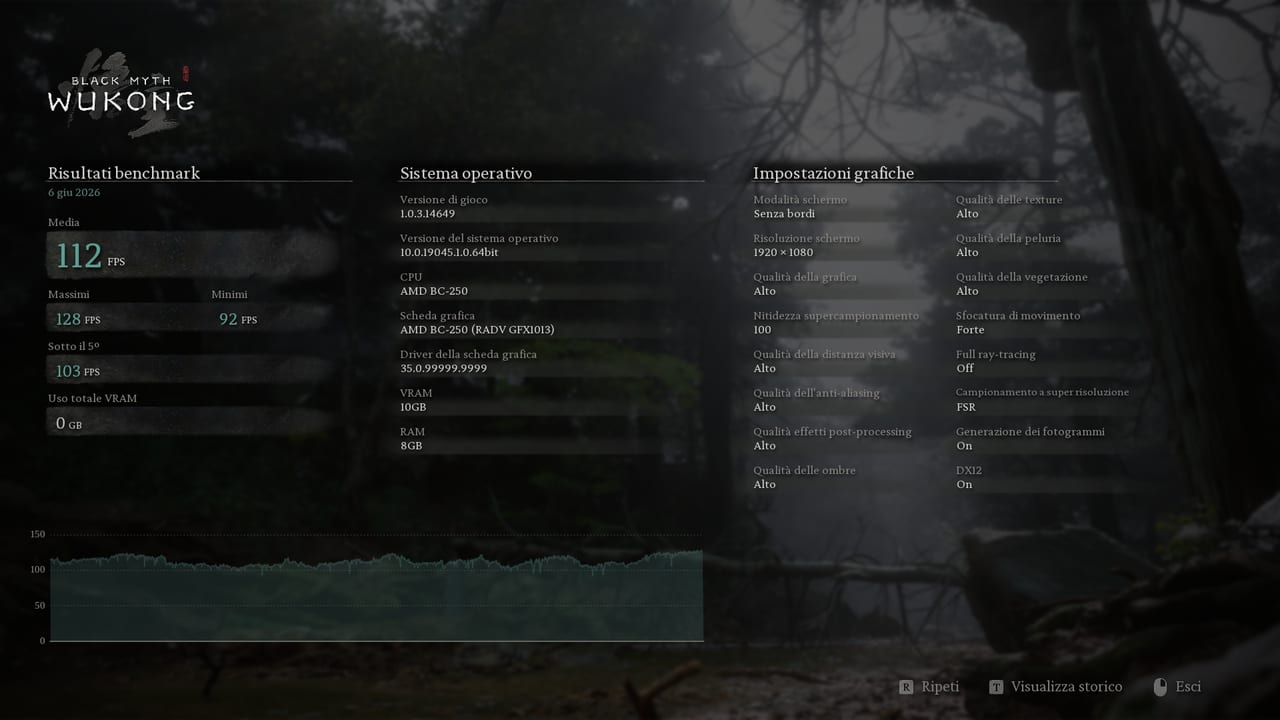
Black Myth: Wukong — 112 FPS (1080p)
| Setting | Value |
|---|---|
| Resolution | 1920×1080 |
| FPS cap | none (uncapped) |
| Load type | CPU / draw-call bound |
| Upscaling | FSR 4 unavailable (RDNA 4) → gamescope FSR1/NIS or OptiScaler |
Result: average 112 FPS · max 128 · min 92 · 1% low 101.
Telemetry during the run (~4 min):
| Metric | Measured value |
|---|---|
| GPU clock | ~1.4–1.6 GHz (not saturated: the game is CPU-bound) |
| GPU edge | 83–86 °C |
| GPU power | ~90–140 W |
| GPU mV | ~970–987 mV |
| CPU clock | ~3.5 GHz (dropped from 3.9 due to the shared budget) |
| CPU temp | 85 °C (at the cap) |
| VRAM | ~1.9 GB (menu) → ~4.4 GB (in game) |
| Fan | ~2950–3140 RPM |
Lesson: in gameplay on a draw-call bound title like Wukong, what matters most is CPU stability under load and good cooling.
Governor Balanced vs Performance (benchmark tool, historical data)
The benchmark tool’s flythrough is GPU-bound, so there the clock matters. This run dates from the old preset governor (retired September 2026): switching to Performance in the Tuner (it held the GPU at its top safe-point under load, idling to 350 MHz):
| Governor mode | Average | 5%-low |
|---|---|---|
| Balanced (default) | 100 FPS | 92 FPS |
| Performance | 111 FPS | 102 FPS |
+11% on the average and on the slowest frames, just from holding the clock high. With today’s V/F governor the equivalent move is raising the preset to Performance (2100 MHz ceiling): measured on Wukong, +4.5% on a cold board and +11% on a warm one versus the stock governor (see GPU & overclock).
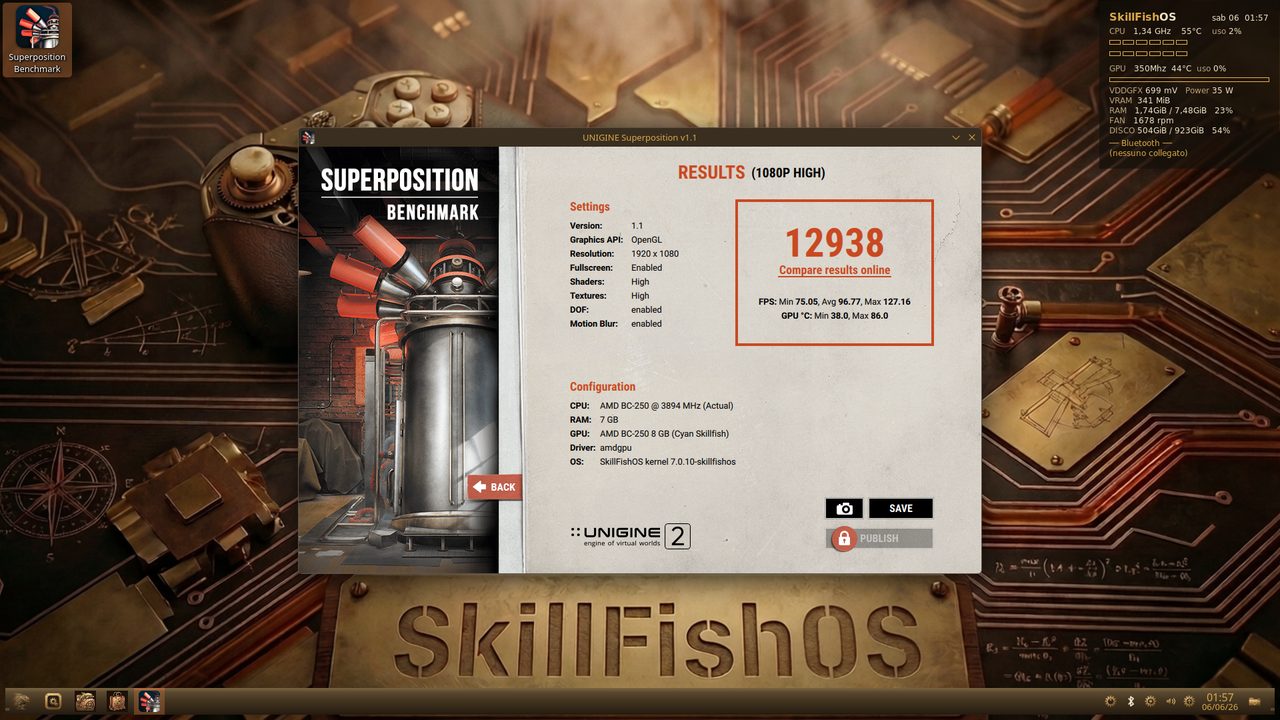
Unigine Superposition — 1080p HIGH: 12938
| Setting | Value |
|---|---|
| Version | 1.1 |
| Graphics API | OpenGL |
| Resolution | 1920×1080, fullscreen |
| Shaders | High |
| Textures | High |
| DOF | enabled |
| Motion Blur | enabled |
Result: score 12,938 · FPS min 75.59 · avg 96.77 · max 127.16. Config read by the tool: CPU AMD BC-250 @ 3894 MHz, RAM 7 GB, GPU AMD BC-250 8 GB (Cyan Skillfish), kernel 7.0.10-skillfishos.
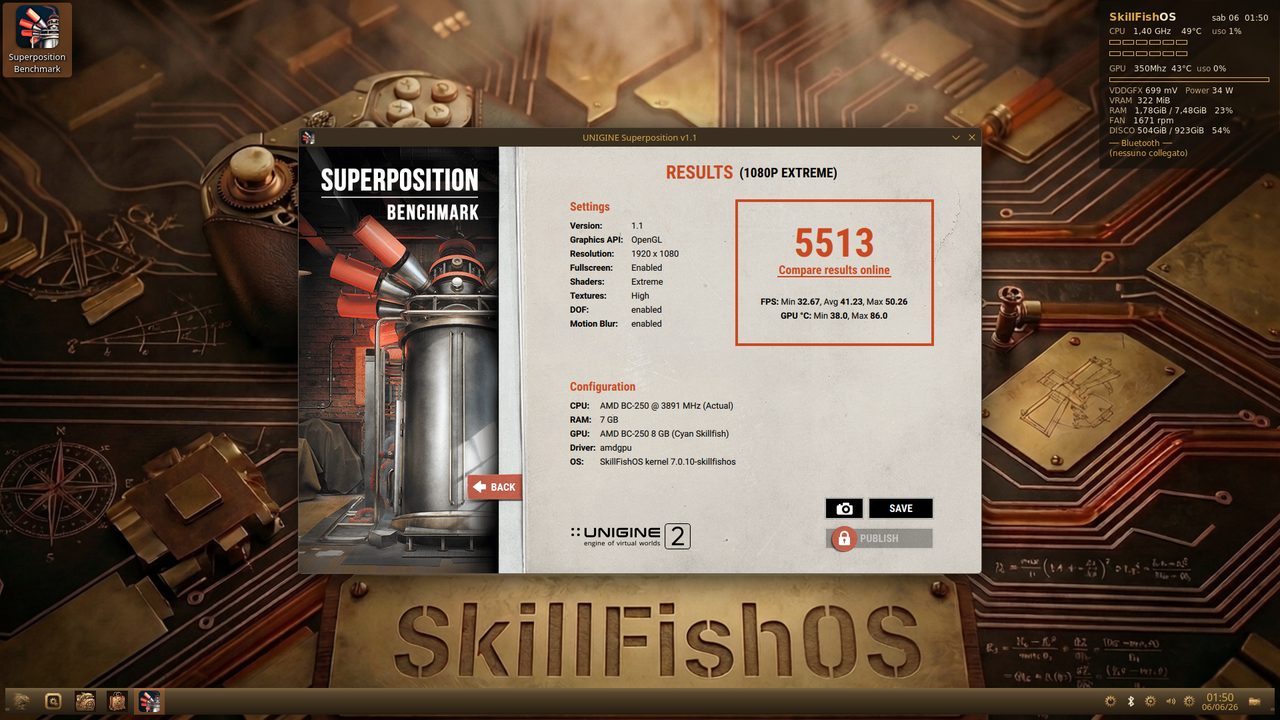
Unigine Superposition — 1080p EXTREME: 5513
| Setting | Value |
|---|---|
| Version | 1.1 |
| Graphics API | OpenGL |
| Resolution | 1920×1080, fullscreen |
| Shaders | Extreme |
| Textures | High |
| DOF | enabled |
| Motion Blur | enabled |
Result: score 5,513 · FPS avg 41.25 (min ~32.8 · max ~49).
 A Superposition scene rendered in real time on the BC-250.
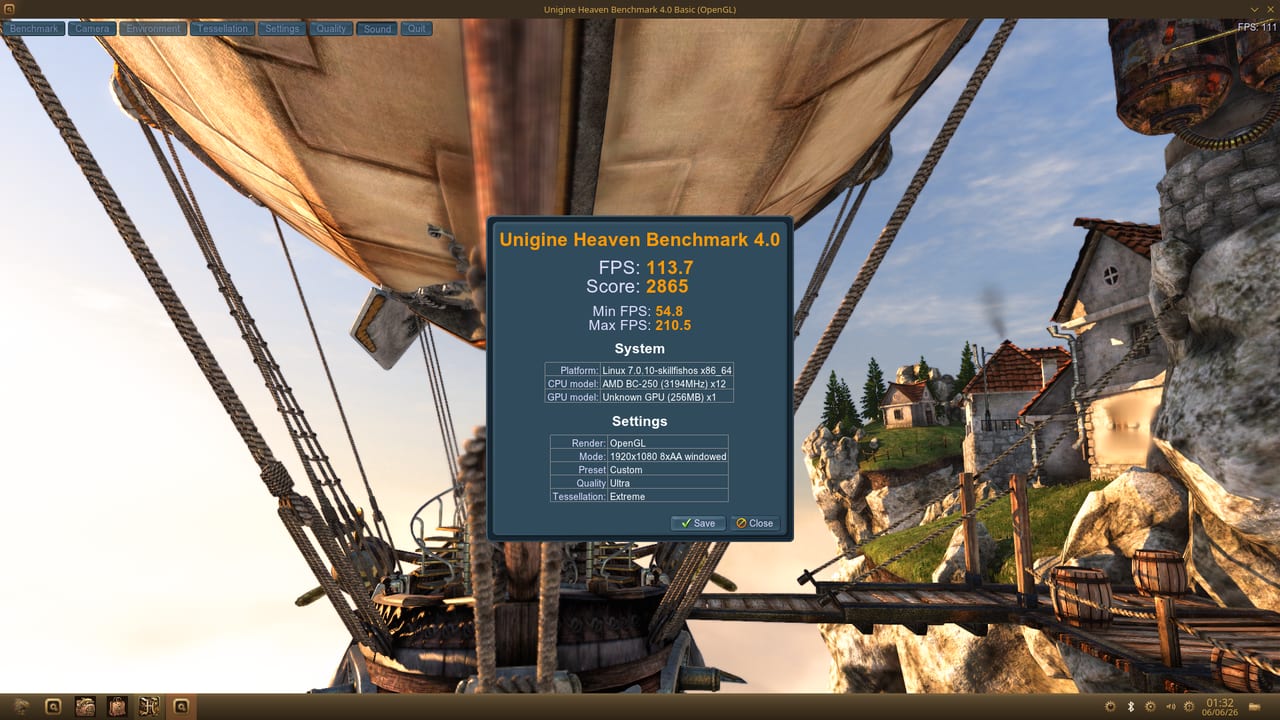
Unigine Heaven 4.0 — 113.7 FPS · score 2865
| Setting | Value |
|---|---|
| Graphics API | OpenGL |
| Resolution | 1920×1080, windowed |
| Anti-aliasing | 8× |
| Quality | Ultra |
| Tessellation | Extreme |
Result: 113.7 FPS · score 2865 · min 54.8 · max 219.5. Platform read by the tool: Linux 7.0.10-skillfishos x86_64 · CPU AMD BC-250 ×12 · GPU gfx1013.
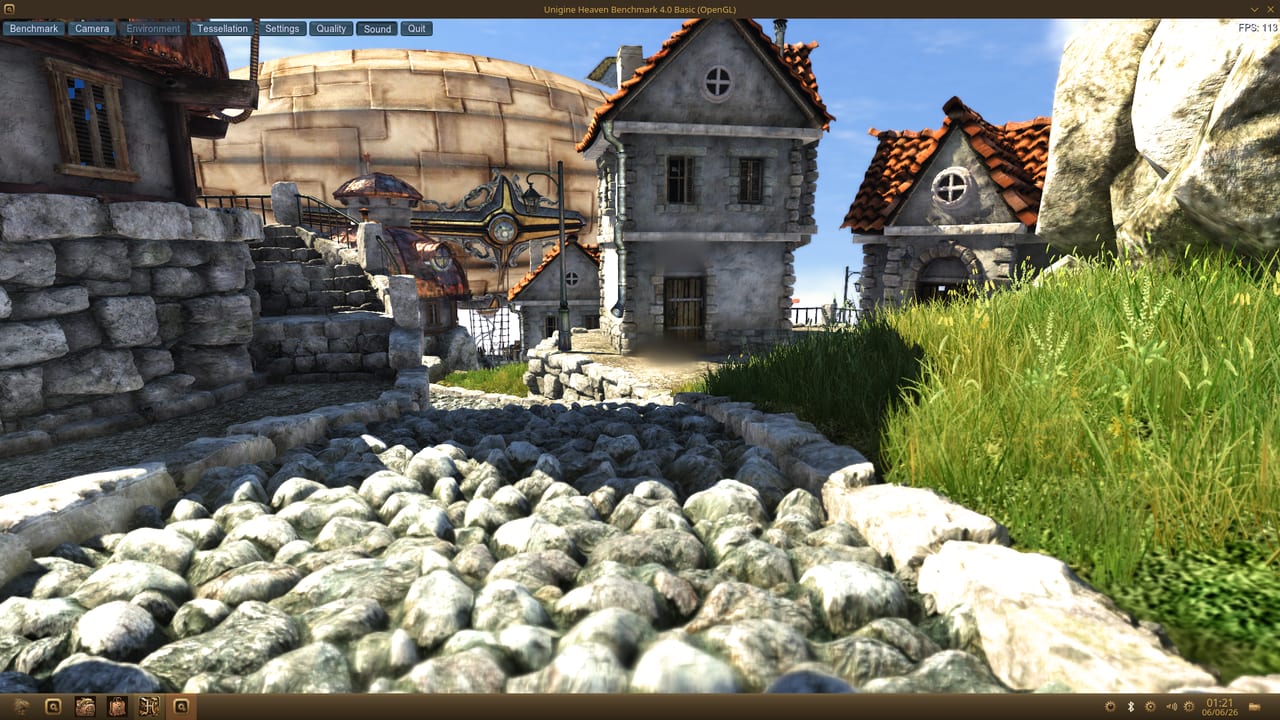 The Heaven scene rendered in real time on the BC-250 during the run.
GPU compute — vkpeak (synthetic)
Vulkan compute throughput on the same board, before and after unlocking the 40 CUs.
| Metric | Baseline 24 CU | SkillFishOS 40 CU |
|---|---|---|
| FP32 scalar | 6141 GFLOPS | 11,329 GFLOPS (11,385 cold) |
| FP16 vec4 | 12,260 | 22,685 |
| int8 dot-product | 24,550 GIOPS | 45,495 GIOPS |
| FP64 scalar | 385 | ~640 |
| copy d2d (internal bandwidth) | — | 191 GBPS |
With the 40 CUs active: +85% FP32 over baseline (≈11.3 TFLOPS). When hot, under sustained stress, it settles around 10,214 GFLOPS. At idle the governor drops to 350 MHz, edge ~54 °C after the load.
Memory bandwidth — clpeak
| Metric | Value |
|---|---|
| Measured GDDR6 bandwidth | ~350–367 GB/s |
mclk adjustable |
No (fixed memory clock) |
| Memory seen by Vulkan | ~13 GiB (with extended GTT) |
The four original profiles — clocks, voltages, temperatures (historical data)
Until September 2026 the Tuner offered four profiles that paired CPU and GPU together. They’ve been retired: today the CPU is tuned with independent sliders (frequency, undervolt, thermal limit) and the GPU with a three-preset curve — Cautious 1850 · Balanced 2000 · Performance 2100 MHz — see GPU & overclock. The data below remains as a historical measurement of the hardware:
| Profile (retired) | CPU | CPU voltage | GPU | Peak temp |
|---|---|---|---|---|
| Stock | 3500 MHz | — | 1500 MHz | the lowest |
| Performance | 3700 MHz | ~1106 mV (scale −16) |
2000 MHz | balanced |
| Turbo | 3900 MHz | ~1199 mV (scale −24) |
2230 MHz | < 85 °C (cap) |
| Crazy | 4.0 GHz | ~1224 mV (scale −36) |
2230 MHz | ~83 °C in 120 s stress |
- Hard maximum Vid: 1.325 V (never exceeded — still true today).
- 85 °C thermal cap; fan on auto; at idle the GPU sits at 350 MHz / 700 mV.
The 8-core unlock — a real +20%
The BC-250 ships with two cores disabled in software: the SMU’s core-enable mask reads 3 of 4 cores per CCX. SkillFishOS rewrites it and brings the CPU to 8 cores / 16 threads, with no patched BIOS. The same unlock can also be done before boot, with an EFI program, in a single reboot instead of the extra reboot the system service needs.
Measured on the same boot, toggling the two extra cores off and on at runtime:
| Workload | 6c/12t | 8c/16t | |
|---|---|---|---|
xz -T compression |
6.41 s | 5.11 s | +20% |
| CPU LLM inference | 34.0 tok/s | 40.8 tok/s | +20% |
| Temperature | 66 °C | 68 °C | +2 °C |
It’s +20% rather than the theoretical +33%: memory bandwidth and thread overhead eat the difference. Still a fifth more performance for free.
Overclocking with all 8 cores
Re-measured step by step, every rung stable with 0 MCEs:
| Target | Reached under load | Score | Temp | Fan |
|---|---|---|---|---|
| 3500 (control) | 3475 | 5118 ev/s | 57 °C | — |
| 3700 | 3673 | 5410 | 62 °C | 50% |
| 3900 | 3872 | 5704 | 71 °C | 68% |
| 4000 | 3971 | 5849 | 81 °C | 93% |
Stable maximum: 4000 MHz, +14% on the score over 3500 — only reachable once the fan control was fixed. Warning: Under a combined CPU+GPU load the clock settles at 3375–3492 MHz at 86 °C: past ~3900 the limiter is the heatsink, not the silicon.
Thermal validation (stress test)
Data recorded during the Tuner’s automatic validation (test-and-rollback).
| Phase | Clock | Temperature | Notes |
|---|---|---|---|
| Idle | CPU ~2.5 GHz · GPU 350 MHz | k10 46 °C · GPU 45 °C | at rest |
| CPU stress (12 threads, 120 s) | CPU 3.68–3.69 GHz | k10 85 °C (at the cap) | historical figure, taken before the 8-core unlock |
| GPU stress (vkpeak loop, 120 s) | GPU 2000 MHz | edge up to 86 °C | at 86 °C the governor drops to 1819–1900 MHz (thermal-guard); the CPU falls to ~2.2–2.4 GHz due to the shared budget |
Comparisons
Same hardware, just changing the OS — Superposition 1080p Extreme on the same BC-250:
| System | Score |
|---|---|
| SkillFishOS (GPU 2230 · CPU 3900, 40 CU — Crazy preset, retired) | 5513 |
| Other distro (Bazzite, stock clocks) | 4102 |
→ +34% real performance from the very same chip, thanks to 40 unlocked CUs, a governor pushing 2230 MHz and CPU OC+undervolt.
Versus desktop Radeons (Superposition 1080p High): the BC-250 with SkillFishOS (12,938) matches an RX 6600 / 6600 XT costing €200+, with raw compute of an RX 6700 (~11.3 TFLOPS) — on a ~€50 board.
Tools and method
| Tool | What it measures |
|---|---|
| vkpeak | FP32/FP16/int8 throughput via Vulkan |
| clpeak | memory bandwidth and OpenCL throughput |
| sysbench | CPU stress/benchmark (also used by the Tuner) |
| Unigine Superposition / Heaven | OpenGL graphics benchmarks |
| In-game MangoHud | FPS and frametime in real games |
| custom telemetry | clock/temp/power/fan via amdgpu sysfs, k10temp, nct6686 |
Sources
- vkpeak · clpeak · sysbench · Unigine
- bc250-40cu-unlock (duggasco) — CU unlock
- bc250.info — community safe-points and thermal notes
- OptiScaler — per-game upscaling